Description
Aluminum Door Leaf
Why Is Cold Room Door Leaf Manufacturing So Important?
A cold room door leaf is not merely a surface that opens and closes. It also:
- Preserves the internal temperature of the cold room
- Minimizes energy losses
- Determines the mechanical stability of the door
- Provides a proper working base for door gaskets
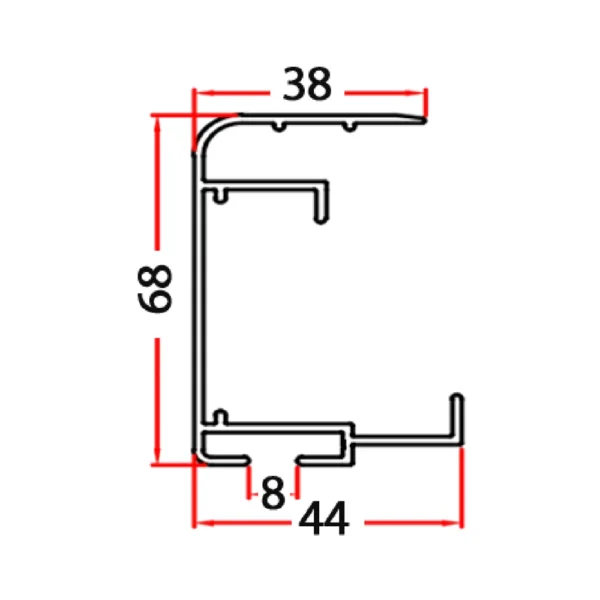
Especially positive temperature cold room doors are exposed to frequent opening and closing cycles. Therefore, the door leaf must be both mechanically strong and highly insulated. At this point, the BOB-30561 Aluminum Door Leaf Profile forms the main structural backbone of the door leaf.
Cold Room Door Leaf Manufacturing Process with BOB-30561
The BOB-30561 is designed for cold room door leaves produced using the polyurethane injection method. The manufacturing process consists of the following steps:
- Aluminum Profile Preparation
The BOB-30561 aluminum profiles are precisely cut according to the required door dimensions and assembled to form the perimeter frame of the door leaf.
- Placement of Metal Sheet Surfaces
Metal sheets forming the inner and outer surfaces of the door leaf are positioned in accordance with the profile geometry.
- Thermal Isolation Between Sheet and Aluminum
In this profile, thermal transfer between the metal sheet and the aluminum profile is interrupted by using either:
- BOB-P571, or
- BOB-P66
These products act as thermal isolation strips placed between the aluminum profile and the sheet metal.
Thanks to this application:
- Direct contact between aluminum and metal sheet is eliminated
- Thermal bridges are prevented
- Overall insulation performance of the door leaf is significantly improved
- Polyurethane Injection Stage
High-density polyurethane foam is injected into the prepared door leaf mold. During expansion, polyurethane:
- Provides superior thermal insulation
- Converts the door leaf into a single monoblock structure
- Increases mechanical strength and rigidity
Compatibility with Polyurethane Injection System
The BOB-30561 Aluminum Door Leaf Profile is geometrically optimized for polyurethane injection systems. This ensures:
- Uniform distribution of polyurethane inside the door leaf
- Elimination of voids and deformation risks
- Long-term dimensional stability
These features are especially important for positive temperature cold room doors, which are widely used in food storage and logistics facilities.
Application Areas for Positive Temperature Cold Room Doors
The BOB-30561 is used for manufacturing door leaves operating in positive temperature ranges, including:
- Cold room hinged door leaf
- Cold room sliding door leaf
- Cold room automatic sliding door leaf
- Cold room monorail sliding door leaf
This wide application range makes BOB-30561 suitable for both small-scale and large industrial cold room projects.
Gasket Compatibility and Sealing Performance
High insulation performance is completed by selecting the correct gasket. The BOB-30561 Aluminum Door Leaf Profile is compatible with the following gasket models:
- BOB-K23
- BOB-K31
- BOB-K59
- BOB-K19
- BOB-K4
- BOB-K6
- BOB-K3
- BOB-P579
- BOB-P240
These gaskets ensure:
- Full contact between door leaf and frame
- Prevention of air and moisture leakage
- Improved energy efficiency
- Reduced condensation and frost formation
Advantages of Anodized Aluminum Profile
The BOB-30561 is manufactured from anodized aluminum, which provides:
- High resistance to corrosion
- Excellent performance in humid environments
- Hygienic and easy-to-clean surfaces
- A professional and aesthetic appearance
- Long service life
These properties are particularly important for cold rooms used in the food industry.
Conclusion
The BOB-30561 Aluminum Door Leaf Profile is a reliable and professional solution developed for positive temperature cold room door leaves manufactured with the polyurethane injection system.
By combining:
- High insulation performance
- Thermal isolation using BOB-P571 or BOB-P66
- Wide gasket compatibility
- Strong anodized aluminum structure
this profile meets modern cold room door requirements at the highest level.