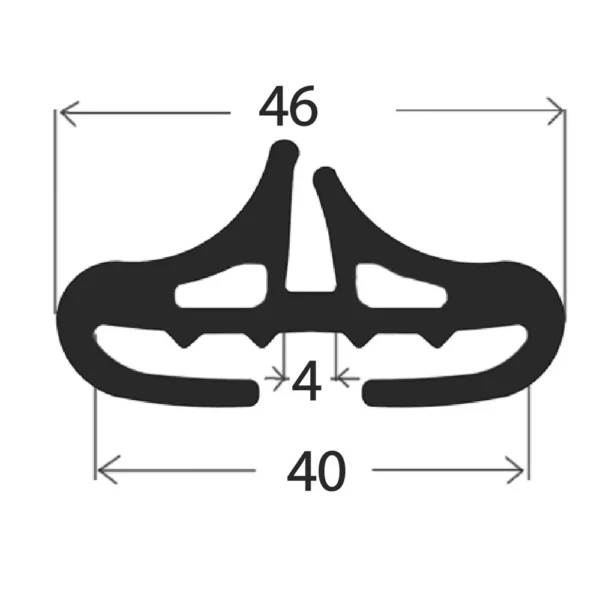
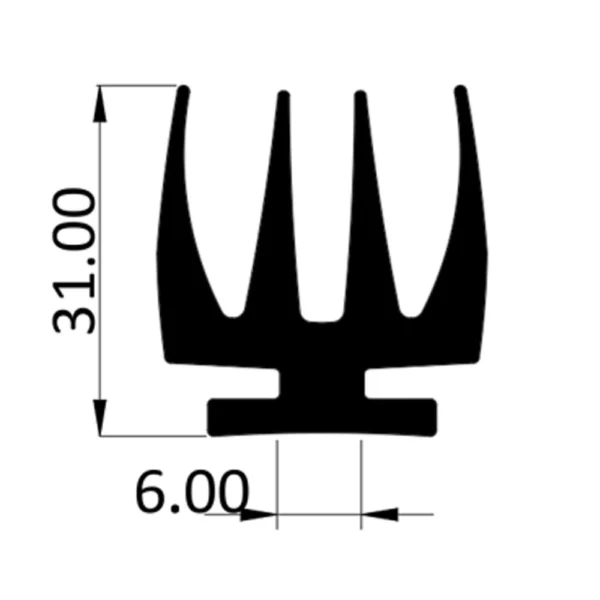
Description
Importance of Door Sealing in Cold Rooms
Cold room doors are opened and closed repeatedly throughout daily operations. This continuous movement exposes the door sealing system to mechanical stress, temperature differences, and environmental effects. Without a reliable sealing solution, cold air escapes through door gaps while warm air enters the cold room, forcing refrigeration systems to work harder.
The Cold Room Door Rubber acts as a flexible and durable barrier that seals the contact points between the door leaf and the frame or threshold. By eliminating gaps, it:
- Prevents cold air leakage
- Blocks warm air infiltration
- Reduces condensation and ice formation
- Improves door closing performance
- Supports long-term energy savings
In many applications, this product is also referred to as a cold room door gasket, highlighting its primary sealing function.
Ideal Solution for Channel-Free Aluminum Door Profiles
Many cold room doors, especially older models or custom-built systems, are manufactured using aluminum door profiles without gasket channels. In such cases, conventional snap-in or channel-based gaskets cannot be installed without additional machining or profile replacement.
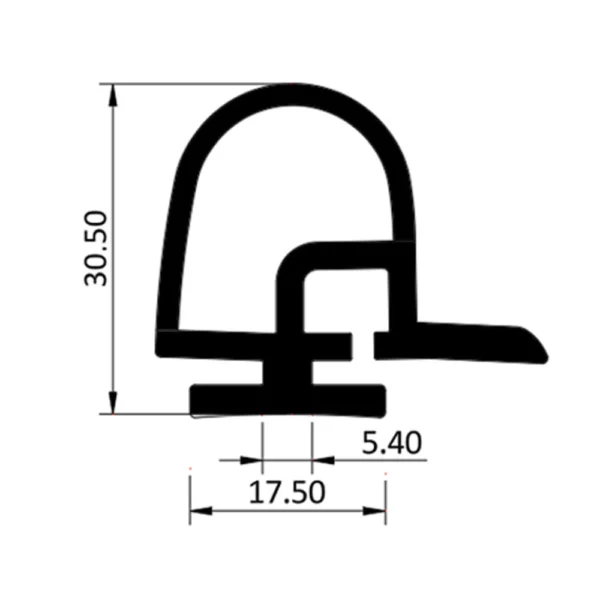
The Cold Room Door Rubber (BOB-P329) is specifically designed for these situations. Its flat, non-toothed base geometry allows easy installation on aluminum door profiles that do not include a gasket channel. This makes it an ideal solution for:
- Channel-free aluminum door profiles
- Retrofit and maintenance applications
- Door upgrades without structural modifications
Thanks to this design, the cold room door gasket can be installed quickly and efficiently without altering the door structure.
Special Geometry with Dual-Chamber Design
One of the defining features of the Cold Room Door Rubber is its special geometric structure. The product consists of:
- A flat base section
- A body with two separate internal chambers (dual cavities)
This dual-chamber design provides both flexibility and secure fixation. During installation, a U-shaped PVC strip or metal sheet is inserted between the two chambers. This strip allows the rubber to be firmly fixed to the door leaf using screws.
This installation method ensures that:
- The rubber remains securely in place
- Detachment or deformation over time is prevented
- Sealing performance remains consistent
- Long service life is achieved
Easy and Reliable Installation Method
The installation process of the Cold Room Door Rubber is simple and practical, making it highly suitable for on-site applications. The mounting process involves:
- Positioning the rubber along door edges or thresholds
- Inserting a U-shaped PVC or metal strip between the chambers
- Fixing the assembly to the door using screws
No complex tools or specialized equipment are required. This ease of installation makes the product especially valuable during maintenance and renovation of older cold room doors, where minimizing downtime is essential.
High-Quality PVC Material for Cold Storage Conditions
The Cold Room Door Rubber (BOB-P329) is manufactured from high-quality PVC material, selected specifically for cold storage applications. PVC offers several advantages in such environments:
- Maintains flexibility at low temperatures
- Resistant to cracking and hardening
- Unaffected by moisture and condensation
- Long-lasting elastic properties
These characteristics ensure that the cold room door gasket maintains effective sealing performance even under continuous temperature fluctuations and frequent door operation.
Effective Sealing at Door Edges and Thresholds
The product is primarily used at:
- Door edges
- Door bottom thresholds
These areas are the most common points of air leakage in cold room doors. The Cold Room Door Rubber fills these gaps effectively, creating a uniform and continuous seal around the door perimeter.
By improving sealing at these critical points, the product directly contributes to thermal stability and energy efficiency in cold storage environments.
Compatibility with Hinged and Sliding Cold Room Doors
The Cold Room Door Rubber is suitable for use with both:
- Cold room hinged doors
- Cold room sliding doors
This wide compatibility makes it a versatile sealing solution for various cold room door systems. In sliding doors, the rubber’s flexibility ensures smooth door movement while maintaining consistent sealing performance.
Ideal for Maintenance and Retrofit Projects
Over time, existing cold room door gaskets may lose elasticity, become brittle, or fail to provide proper sealing. In such cases, replacing the entire door is costly and unnecessary.
The Cold Room Door Rubber (BOB-P329) offers a cost-effective maintenance solution by restoring sealing performance without replacing the door structure. This makes it highly suitable for:
- Renovation of older cold rooms
- Preventive maintenance programs
- Energy efficiency upgrades
Application Areas
The Cold Room Door Rubber is widely used in:
- Industrial cold storage facilities
- Modular cold rooms
- Food storage and processing plants
- Pharmaceutical and medical cold rooms
- Cold room hinged door systems
- Cold room sliding door systems
Technical Specifications
- Product Name: Cold Room Door Rubber
- Manufacturer: Bob Modüler
- Product Code: BOB-P329
- Material: PVC
- Geometry: Flat base, dual-chamber body
- Installation: Screw fixing with U-shaped PVC or metal strip
- Application Areas: Door edges and thresholds
Conclusion
The Cold Room Door Rubber (BOB-P329) is a practical, durable, and efficient sealing solution for cold room doors manufactured with channel-free aluminum profiles. Its special geometry, high-quality PVC material, and simple installation method make it ideal for both new installations and retrofit projects. By improving door sealing performance, this cold room door gasket plays a direct role in reducing energy loss, enhancing thermal stability, and extending the service life of cold room door systems.