Description
Operating Temperature Range – From +60°C to -50°C
Cold room sliding door systems manufactured according to BOB Modular Standards can be designed to operate within a wide temperature range from +60°C down to -50°C, depending on project requirements. This broad range allows the system to be used not only in standard cooling applications but also in facilities with multiple temperature zones and demanding operational conditions.
At temperatures close to +60°C, stable door performance depends on correct frame selection, proper door leaf structure, accurate gasket placement, and suitable accessory configuration. At temperatures reaching -50°C, risks such as freezing, icing, and loss of airtightness increase significantly. Therefore, sealing solutions and auxiliary heating components become critically important.
In this context, frozen rooms (deep-freeze cold storage areas) represent one of the most demanding applications for sliding door systems. Door performance in frozen rooms is directly related to reinforced sealing structures and effective anti-icing solutions.
Cold Room Sliding Door Leaf – Structure and Manufacturing Details
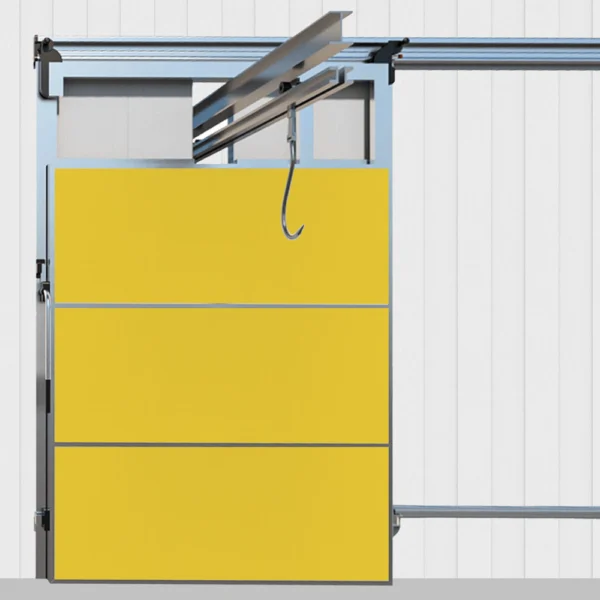
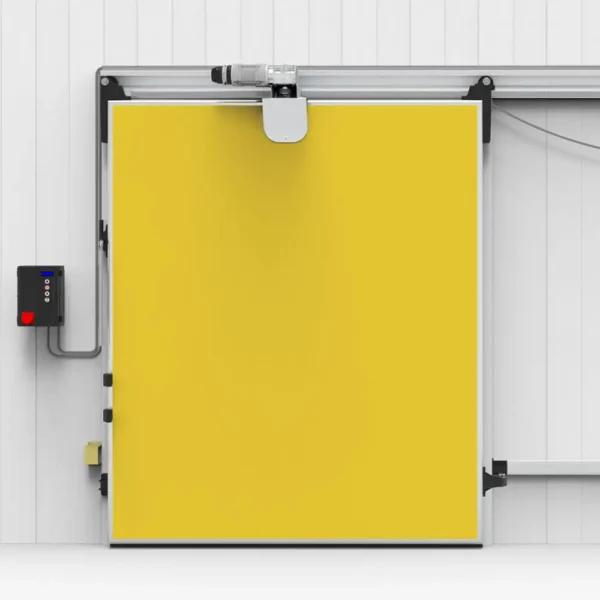
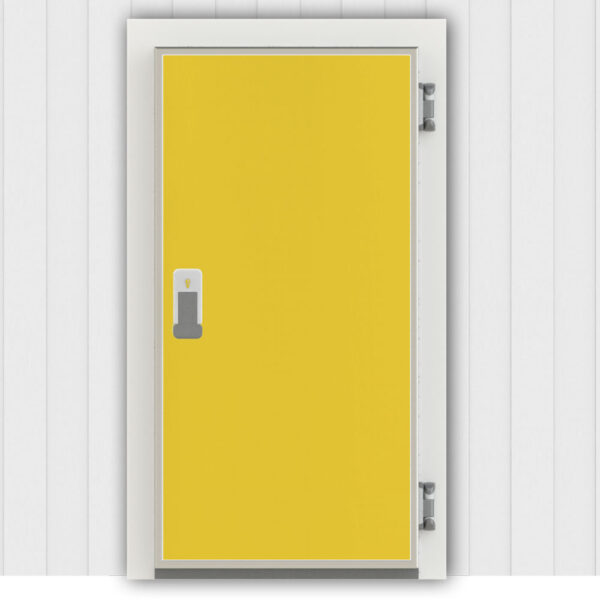
The cold room sliding door manufactured according to BOB Modular Standards is produced to deliver high durability and thermal insulation performance in Cold Room and Cold Storage environments.
The door leaf frame is constructed using anodized aluminum profiles, providing high mechanical strength and long-term dimensional stability under low-temperature conditions. Metal sheets are then placed into the aluminum profiles to form the outer surfaces of the door leaf.
After assembling the door leaf body, polyurethane injection with a density of 42 kg/m³ is applied to the internal cavity. This insulation core ensures high thermal performance required for cold room and cold storage applications. Thanks to the polyurethane injection, the cold room sliding door minimizes energy losses and maintains stable internal temperatures.
Door leaf surface materials can be customized according to customer requirements:
- Stainless steel sheet
- PVC-coated sheet
- Polyester-coated sheet
Sheet colors can also be selected to meet architectural and operational requirements of cold room and cold storage projects. In the final stage, gaskets are installed into the aluminum channels, completing the door leaf assembly.
Frozen Rooms – Double Gasket System and Heating Cable Importance
In frozen room applications operating at very low temperatures, airtightness at the junction between the door leaf and the frame must be reinforced. In such cases, a double gasket system is used to create two independent sealing lines, significantly reducing air leakage.
The double gasket system supports temperature stability inside frozen rooms while also limiting moisture ingress from the outside. Reduced moisture entry is one of the most effective ways to prevent icing and freezing problems around sliding doors.
Additionally, the use of a heating cable (resistance cable) is critically important in frozen room applications. Heating cables help prevent ice formation in critical areas such as the door frame and sealing zones. In extremely low temperatures, moisture entering from outside may condense and freeze, making door operation difficult. The heating cable reduces this risk and ensures reliable opening and closing of the sliding door, preserving operational continuity and minimizing mechanical wear.
Cold Room Sliding Door Frames – Systems Compatible with Cold Storage and Frozen Rooms
In cold room sliding door systems manufactured according to BOB Modular Standards, door frames are offered in three main groups depending on project requirements. The door frame is a critical component for smooth door operation and airtight sealing.
1️⃣ PVC Door Frames
PVC frame systems are commonly used in standard Cold Storage and medium-scale Cold Room applications, offering easy installation and cost efficiency.
PVC frame profiles used:
- Sliding Door PVC Main Frame Profile – BOB-10063
- PVC Frame Profile (Rear Return Profile) – BOB-10014
- PVC Frame Profile – BOB-10012
These PVC frames provide clean and airtight transitions at panel junctions in cold room sliding door systems.
2️⃣ Aluminum Door Frames
Aluminum frame systems are preferred for intensive-use Cold Room, Cold Storage, and Frozen Room projects, offering high rigidity and long service life.
- Thermal Break Aluminum Frame Profile – BOB-106
The thermal break structure minimizes thermal bridges, improving energy efficiency and reducing icing risk around the door frame, especially in frozen room applications.
3️⃣ Stainless Steel Door Frames
Stainless steel frames are used in cold room and cold storage projects where high hygiene standards are required, such as food processing, meat handling, and pharmaceutical storage facilities.
Cold Room Sliding Door Rail System – High-Strength Aluminum Construction
One of the most critical components of a cold room sliding door is the rail system. The rails are manufactured from anodized, high-strength aluminum profiles.
Main rail profiles used:
- Aluminum Main Rail Profile – BOB-9016A
- Aluminum Carrier Rail Profile – BOB-9017
Rail guides (also known as rail ramps):
- BOB-1002R
- BOB-1002L
Stainless steel rail covers:
- BOB-1003R
- BOB-1003L
Side Guide System – Balanced Door Movement
The side guide system ensures smooth and balanced door movement during opening and closing.
- Aluminum Side Guide Profile – BOB-30115
- Fork Bracket – BOB-3005R / BOB-3005L
- Side Guide Cover – BOB-3006R / BOB-3006L
Accessories Structure
Accessories used in cold room sliding door systems manufactured according to BOB Modular Standards are produced from:
- Special engineering plastic composite material, or
- Stainless steel upon customer request
This structure allows the system to meet hygiene and durability requirements of various cold room, cold storage, and frozen room projects.
Where Is the Sliding Door Used?
- Cold Room (Buzhane)
- Cold Storage facilities
- Frozen rooms
- Food production and processing plants
- Logistics and distribution centers
- Large-opening cold room areas
- Industrial kitchens
Conclusion
The cold room sliding door manufactured according to BOB Modular Standards is a complete Cold Room Door solution for Cold Room, Cold Storage, and Frozen Room projects, featuring a strong door leaf structure, updated PVC frame profiles, BOB-106 thermal break aluminum frame, high-strength rail systems, and balanced side guide mechanisms. With product code BOB-SK200, this sliding door provides long service life, reliable operation, and the ability to operate across a wide temperature range from +60°C to -50°C. In frozen room applications, the double gasket system and heating cable play a key role in preventing icing and ensuring uninterrupted door operation.