Description
Cold Room Door EPDM Rubbers
Importance of Door Rubber in Sliding Cold Room Applications
Sliding cold room doors operate by moving horizontally along a rail and applying lateral pressure to the door frame when closed. This working principle requires the door rubber to adapt continuously to movement without losing contact with the frame.
An effective cold room door rubber must:
- Maintain uniform contact with the door frame
- Withstand repeated opening and closing cycles
- Retain elasticity in low-temperature environments
- Prevent air infiltration and moisture penetration
If the door rubber does not meet these requirements, problems such as cold air leakage, condensation, ice formation, and increased energy consumption may occur. BOB-K31 is developed specifically to eliminate these risks and to provide consistent sealing performance in sliding door systems.
EPDM Material for Cold Storage Performance
BOB-K31 Cold Room Door Rubber is manufactured from high-quality EPDM (Ethylene Propylene Diene Monomer). EPDM is one of the most reliable elastomers used in cold storage applications due to its resistance to low temperatures, humidity, and mechanical fatigue.
Key advantages of EPDM include:
- Excellent flexibility at sub-zero temperatures
- Resistance to cracking, aging, and hardening
- High durability in humid and condensing environments
- Long service life with minimal maintenance
These material properties ensure that BOB-K31 remains flexible and effective even under intensive operating conditions.
Co-Extruded Structure for Optimized Sealing
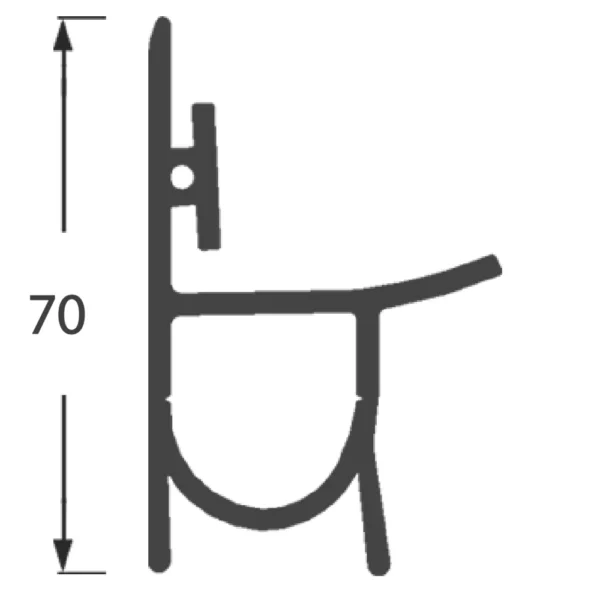
BOB-K31 features a co-extruded (co-ex) structure that combines different EPDM densities within a single profile. This advanced structure allows each section of the door rubber to perform its specific function efficiently.
The co-ex design consists of:
- Lower section (inserted into the aluminum door profile):
Solid EPDM providing strong mechanical grip and secure fixation - Upper section (contacting the door frame):
Sponge EPDM that compresses easily to create a tight and uniform seal
This combination results in a balanced structure that offers both durability and high sealing efficiency.
T-Shaped Base Geometry and Installation Method
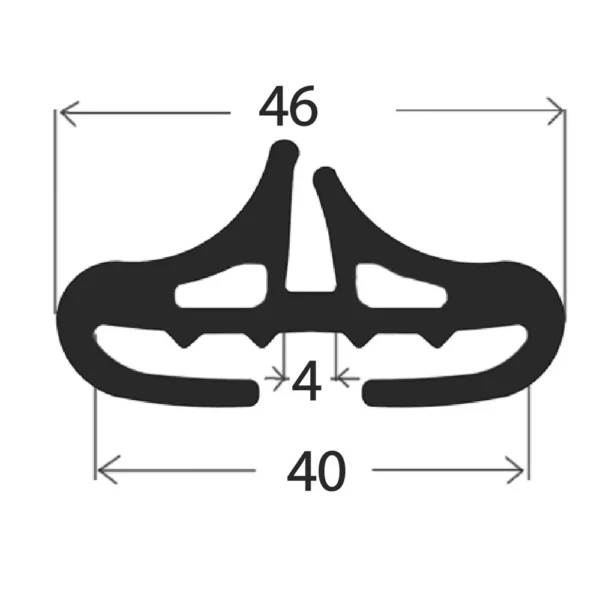
The part of BOB-K31 Cold Room Door Rubber that fits into the aluminum door leaf profile features a T-shaped base geometry. This design ensures mechanical locking inside the aluminum channel.
Installation method:
- The door rubber is inserted into the aluminum profile channel by sliding it laterally
- The horizontal arms of the T-shape expand inside the channel
- The rubber is firmly fixed and remains stable during door operation
This installation technique prevents loosening over time and supports long-term reliability.
Integrated Heating Cable Channel for Anti-Freezing Protection
One of the defining features of BOB-K31 is its integrated heating cable channel. Sliding cold room doors are especially vulnerable to ice formation due to frequent door movement and moisture exposure.
Heating cables are commonly used to prevent freezing; however, in many traditional designs, these cables are embedded inside the door rubber, making replacement difficult. BOB-K31 solves this issue with a dedicated channel that allows the heating cable to be:
- Installed easily without damaging the door rubber
- Removed and replaced quickly when necessary
- Maintained without dismantling the door system
This feature significantly reduces maintenance time and operating costs.
Compatibility with BOB-REZ01 Heating Cable
BOB-K31 Cold Room Door Rubber is fully compatible with BOB-REZ01 Heating Cable for Cold Room Doors (Cuttable). When used together:
- Heating cable length can be adjusted according to door dimensions
- Ice formation around the door perimeter is effectively prevented
- Maintenance and service operations are simplified
This compatibility makes BOB-K31 a practical and efficient sealing solution for cold room doors operating in freezing environments.
Dimensional Difference for Project Adaptability
While BOB-K31 shares the same structural design and functional characteristics as other models within its product family, it is produced with a different dimensional configuration. This allows compatibility with various aluminum door profiles and project-specific requirements.
Dimensional variation provides:
- Easier integration into different door systems
- Improved installation accuracy
- Consistent sealing performance across multiple projects
Energy Efficiency Contribution
Effective door sealing is one of the most important factors in reducing energy consumption in cold storage facilities. Cold Room Door Rubber (BOB-K31) contributes to energy efficiency by:
- Preventing cold air leakage
- Stabilizing internal temperatures
- Reducing the workload on refrigeration systems
- Lowering operational energy costs
Application Areas
BOB-K31 Cold Room Door Rubber is widely used in:
- Industrial cold storage facilities
- Food processing and logistics centers
- Automatic sliding cold room doors
- Monorail sliding door systems
- High-traffic cold storage environments
Technical Specifications
- Product Name: Cold Room Door Rubber
- Manufacturer: Bob Modüler
- Product Code: BOB-K31
- Material: EPDM
- Structure: Co-extruded (solid EPDM + sponge EPDM)
- Base Geometry: T-shaped base
- Special Feature: Integrated heating cable channel
- Compatible Heating Cable: BOB-REZ01
- Application: Sliding, automatic sliding, and monorail cold room doors
Conclusion
Cold Room Door Rubber (BOB-K31) is a durable and service-friendly sealing solution designed for sliding cold room door systems. Its EPDM co-extruded structure, T-shaped base geometry, and integrated heating cable channel provide reliable sealing, easy maintenance, and enhanced energy efficiency. With its dimensional adaptability and compatibility with BOB-REZ01 heating cable, BOB-K31 stands out as a dependable product within Bob Modüler’s cold room door rubber range.