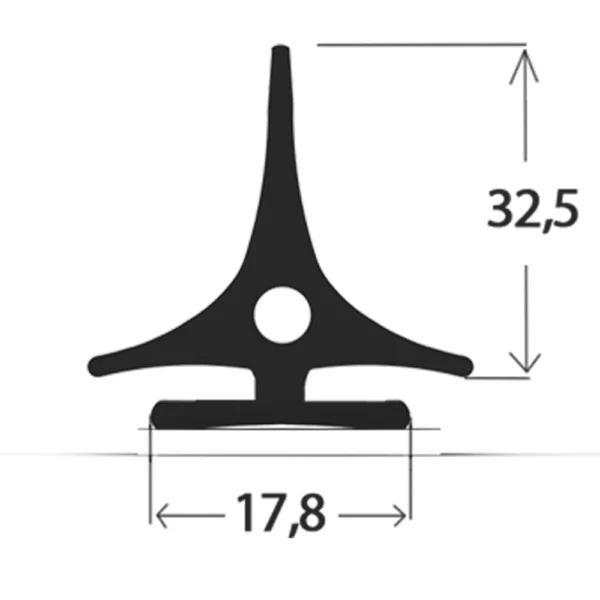
Description
Cold Room Door Rubber
Cold Room Hinged Door EPDM Rubber
Importance of Door Rubber in Cold Storage Facilities
Cold room hinged doors are opened and closed many times during daily operations. Each cycle places mechanical stress on the door rubber, which must compress and recover continuously without losing elasticity. If the door rubber fails to perform properly, several problems may occur:
- Cold air leakage from the cold room
- Entry of warm and humid air
- Condensation and ice formation around the door perimeter
- Increased load on refrigeration systems
- Higher energy and maintenance costs
The Cold Room Door Rubber (BOB-K4) is designed to minimize these risks by maintaining consistent sealing pressure and dimensional stability over long periods of use.
EPDM Material Advantages
BOB-K4 is manufactured from EPDM (Ethylene Propylene Diene Monomer), one of the most widely used rubber materials in cold room applications. EPDM is especially suitable for cold storage doors due to its physical and chemical properties.
Key advantages of EPDM include:
- Excellent elasticity across a wide temperature range
- Resistance to low-temperature hardening and cracking
- High durability against moisture, condensation, and cleaning chemicals
- Long service life under repetitive compression
These characteristics make EPDM an ideal material for cold room door rubber applications.
Co-Ex Structure for Dual Performance
The Cold Room Door Rubber (BOB-K4) features a co-extruded (co-ex) structure, meaning that two different EPDM hardness levels are combined within a single rubber profile. This design allows the rubber to perform two critical functions simultaneously.
The co-ex structure consists of:
- Solid EPDM base, which fits into the aluminum door leaf profile
- Sponge EPDM sealing section, which compresses against the cold room door frame
This dual-material construction ensures both secure fixation and high sealing efficiency.
T-Shaped Base Geometry
A defining feature of BOB-K4 Cold Room Door Rubber is its T-shaped solid EPDM base geometry. This structure differs from arrow-shaped bases and provides a distinct installation and retention method.
Installation of the T-Shaped Base
The T-shaped base is installed as follows:
- The rubber is inserted sideways into the aluminum gasket channel
- The horizontal arms of the “T” mechanically lock into the channel
- Once installed, the rubber remains firmly fixed and does not move vertically
This installation method provides strong mechanical retention and is particularly suitable for factory-assembled cold room hinged doors.
Advantages of the T-Shaped Base Design
The T-shaped base geometry offers several practical advantages:
- Strong and permanent fixation inside the aluminum profile
- Reduced risk of the rubber coming loose during long-term use
- Stable positioning during frequent door operation
- Ideal for doors that are not intended to be frequently disassembled
For these reasons, BOB-K4 is often preferred in cold room door manufacturing processes where durability and long-term stability are priorities.
Sponge EPDM Sealing Section
The upper section of BOB-K4 Cold Room Door Rubber, which presses against the door frame, is made of sponge EPDM. This softer structure compresses easily when the door is closed, adapting to surface tolerances and ensuring uniform contact.
Benefits of the sponge EPDM section include:
- Balanced sealing pressure along the entire door perimeter
- Effective air and vapor tightness
- Reduced noise during door closing
- Improved insulation performance
This combination ensures consistent sealing even if minor alignment variations occur between the door leaf and the frame.
Application in Cold Room Hinged Doors
The Cold Room Door Rubber (BOB-K4) is specifically designed for cold room hinged doors. Hinged door systems require uniform compression and reliable sealing on all sides of the door leaf.
BOB-K4 provides:
- Stable sealing performance under frequent use
- Compatibility with standard aluminum door profiles
- Reliable insulation in industrial cold storage environments
Typical application areas include food storage facilities, refrigerated warehouses, and industrial cold rooms.
Contribution to Energy Efficiency
Door rubbers play a direct role in the energy efficiency of cold storage facilities. BOB-K4 Cold Room Door Rubber helps:
- Reduce cold air leakage
- Maintain stable internal temperatures
- Lower refrigeration system workload
- Decrease overall energy consumption
By maintaining effective sealing, the rubber supports long-term energy savings and operational efficiency.
Difference Between BOB-K4 and BOB-K23
In terms of usage and function, BOB-K4 and BOB-K23 are identical. Both products are used in cold room hinged doors and feature EPDM co-ex structures.
The only difference lies in the base geometry:
- BOB-K4: T-shaped base
- BOB-K23: Arrow-shaped base
This difference affects installation preference rather than sealing performance.
Technical Specifications
- Product Name: Cold Room Door Rubber
- Manufacturer: Bob Modüler
- Product Code: BOB-K4
- Material: EPDM
- Structure: Co-ex (solid EPDM + sponge EPDM)
- Base Geometry: T-shaped solid EPDM
- Application: Cold room hinged doors
Conclusion
Cold Room Door Rubber (BOB-K4) is a robust and reliable sealing solution developed for cold room hinged doors. With its EPDM co-ex structure, T-shaped base geometry, and durable sealing performance, it provides long-term insulation, energy efficiency, and mechanical stability. As a geometry-based alternative to arrow-base models, BOB-K4 offers flexibility in door design while maintaining the same high sealing standards expected from Bob Modüler products.