Description
Cold Room Door Rubber
Importance of Door Rubber in Cold Room Hinged Doors
Cold room hinged doors operate under intensive mechanical and thermal stress. Each opening and closing cycle compresses the door rubber, requiring it to recover its original shape instantly. In addition, the door perimeter is the area most prone to condensation and freezing.
If a door rubber fails to perform correctly, the following problems may occur:
- Cold air leakage from the cold room
- Ice buildup around the door frame
- Difficulty opening and closing the door
- Increased load on refrigeration systems
- Higher energy consumption and maintenance costs
The Cold Room Door Rubber (BOB-K67) is designed to prevent these problems by providing both effective sealing and compatibility with heating cable systems.
EPDM Material for Cold Storage Applications
BOB-K67 is manufactured from EPDM (Ethylene Propylene Diene Monomer), one of the most reliable rubber materials used in cold room applications. EPDM is selected for its ability to maintain elasticity and performance in low-temperature environments.
Key advantages of EPDM include:
- Excellent flexibility at low temperatures
- Resistance to cracking and hardening
- High durability against moisture and condensation
- Long service life under repetitive compression
These properties make EPDM an ideal material for cold room door rubbers, especially in hinged door systems exposed to frequent use.
Co-Ex Structure for Dual Performance
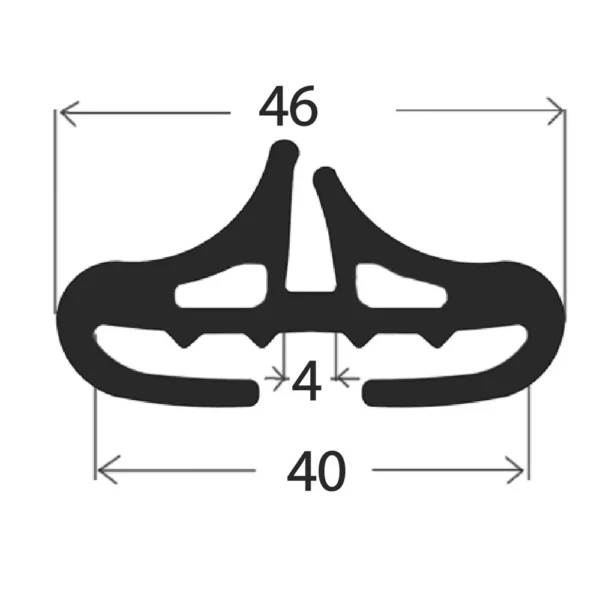
The Cold Room Door Rubber (BOB-K67) features a co-extruded (co-ex) structure, combining two different EPDM characteristics within a single profile.
The structure consists of:
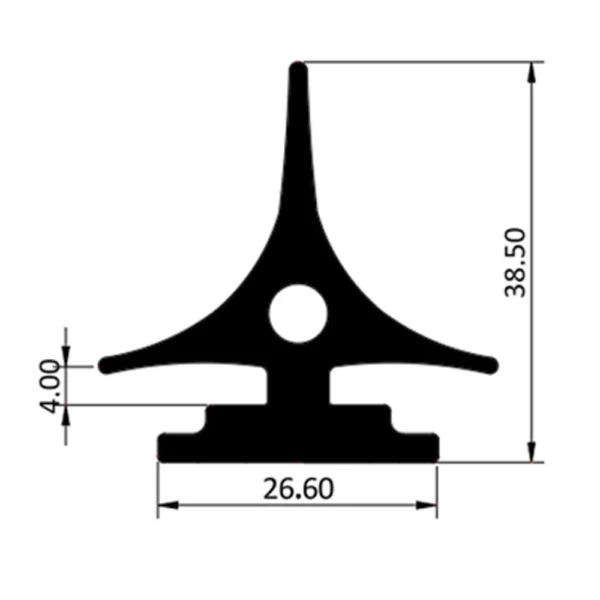
- T-shaped solid EPDM base, inserted into the aluminum door leaf profile
- Sponge EPDM sealing section, which presses against the cold room door frame
This co-ex design ensures both strong mechanical fixation and excellent sealing performance.
T-Shaped Base Geometry and Installation Method
A key structural feature of BOB-K67 is its T-shaped solid EPDM base. This geometry is identical to the base structure used in BOB-K4 and is designed for secure installation into aluminum door profiles.
Installation of the T-Shaped Base
The installation process is as follows:
- The door rubber is inserted sideways into the aluminum gasket channel
- The T-shaped base mechanically locks into the channel
- Once installed, the rubber remains firmly in position and does not slip
This installation method provides strong retention and is especially suitable for factory-assembled cold room hinged doors.
Heating Cable Use in Cold Room Doors
In cold room hinged doors, heating (resistance) cables are commonly used to prevent ice formation. These cables are typically applied in two ways:
- Installed on the door frame
- Installed inside the door rubber
When a heating cable is embedded directly inside a standard door rubber, replacing the cable becomes extremely difficult. The rubber often needs to be removed entirely, resulting in long service times and high labor costs.
Integrated Heating Cable Channel – Key Advantage of BOB-K67
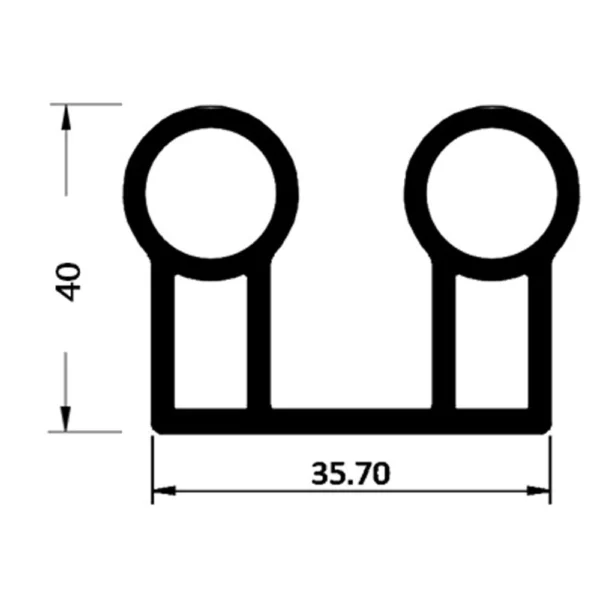
What makes BOB-K67 unique is its integrated heating cable channel, specially designed to allow quick access to the heater cable.
Thanks to this channel:
- The heating cable is not embedded inside the rubber
- The cable is placed into a dedicated channel
- The cable can be removed and replaced within minutes
This design makes BOB-K67 a highly service-friendly solution for cold room hinged doors.
Compatibility with BOB-REZ02 Heating Cable
The heating cable channel of BOB-K67 is designed to work perfectly with BOB-REZ02 (Cold Room Door Heating Cable). This compatibility ensures:
- Proper positioning of the heating cable
- Effective heat distribution along the door perimeter
- Reliable prevention of freezing and icing
Using BOB-REZ02 Cold Room Door Heating Cable together with BOB-K67 provides a complete and efficient anti-freeze sealing system.
Easy Heater Cable Replacement
One of the most significant advantages of Cold Room Door Rubber (BOB-K67) is the ease of heater cable replacement.
With the integrated channel design:
- The door rubber does not need to be removed
- The heating cable can be replaced in minutes
- Maintenance time is drastically reduced
- Labor and service costs are minimized
- Door downtime is kept to a minimum
This feature is especially valuable in large cold storage facilities where operational continuity is critical.
Difference Between BOB-K67 and BOB-K4
In terms of usage and basic sealing function, BOB-K67 and BOB-K4 are identical. Both products:
- Are used in cold room hinged doors
- Are made of EPDM
- Have a co-ex structure
- Use a T-shaped base geometry
The only difference is that BOB-K67 includes an integrated heating cable channel, making it superior in applications where heater cables are required.
Contribution to Energy Efficiency
By preventing ice formation and ensuring full door closure, BOB-K67 Cold Room Door Rubber contributes directly to energy efficiency:
- Eliminates cold air leakage caused by frozen door seals
- Supports stable refrigeration system operation
- Reduces unnecessary compressor workload
- Helps lower overall energy consumption
Technical Specifications
- Product Name: Cold Room Door Rubber
- Manufacturer: Bob Modüler
- Product Code: BOB-K67
- Material: EPDM
- Structure: Co-ex (solid EPDM + sponge EPDM)
- Base Geometry: T-shaped solid EPDM
- Special Feature: Integrated heating cable channel
- Compatible Cable: BOB-REZ02 Cold Room Door Heating Cable
- Application: Cold room hinged doors
Conclusion
Cold Room Door Rubber (BOB-K67) is an advanced sealing solution designed specifically for cold room hinged doors requiring heating cable integration. Its EPDM co-ex structure, T-shaped base geometry, and dedicated heating cable channel provide superior sealing, easy maintenance, and long-term operational efficiency. Fully compatible with BOB-REZ02 Cold Room Door Heating Cable, BOB-K67 minimizes downtime, reduces service costs, and ensures reliable freeze protection in demanding cold storage environments.