Description
Cold Room Door Rubber
Functional Importance in Sliding Cold Room Doors
Unlike hinged doors, sliding cold room doors operate laterally along a rail system. When closed, the door leaf presses horizontally against the door frame rather than vertically. This makes the quality and geometry of the cold room door rubber critically important.
A properly designed cold room door rubber must:
- Apply uniform pressure to the door frame
- Maintain contact during repeated opening and closing cycles
- Resist deformation caused by friction and movement
- Prevent cold air leakage and moisture ingress
If an unsuitable sealing profile is used, several operational issues may occur, including:
- Temperature loss inside the cold room
- Increased energy consumption
- Condensation and ice formation around the door perimeter
- Reduced door performance and service life
BOB-K19 is engineered specifically to prevent these problems and to ensure consistent sealing in sliding door systems.
EPDM Material Performance in Cold Storage
BOB-K19 Cold Room Door Rubber is manufactured from premium-grade EPDM (Ethylene Propylene Diene Monomer). EPDM is one of the most reliable elastomer materials for cold storage applications due to its excellent resistance to low temperatures, humidity, and environmental stress.
Key EPDM advantages include:
- High flexibility at low temperatures
- Resistance to cracking, hardening, and aging
- Excellent performance in humid and condensing environments
- Long service life under intensive use
Thanks to these properties, BOB-K19 maintains its sealing efficiency even in demanding cold storage conditions.
Co-Extruded (Co-Ex) Structure for Optimized Sealing
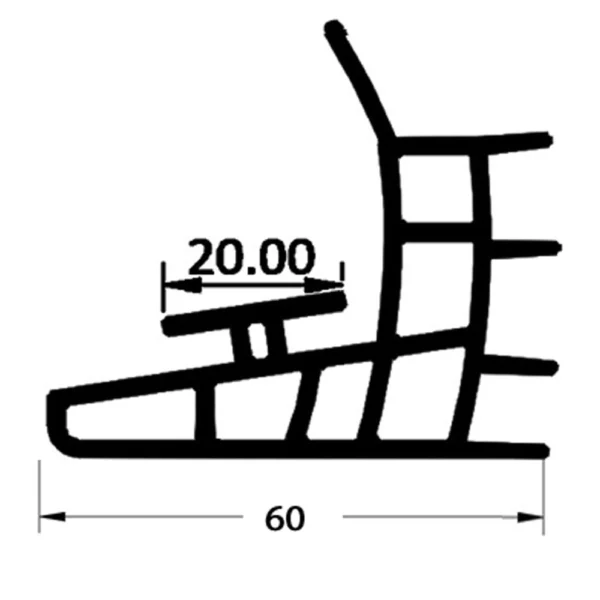
BOB-K19 features a co-extruded (co-ex) structure that combines different EPDM hardness levels within a single profile. This design allows each section of the door rubber to perform its specific function more effectively.
The co-ex structure consists of:
- Lower section (inserted into the aluminum door profile):
Solid EPDM that provides strong mechanical grip and secure fixation - Upper section (contacting the door frame):
Sponge EPDM that compresses easily to create a tight seal
This balanced construction ensures both durability and high sealing performance, making BOB-K19 ideal for sliding and automatic sliding door systems.
T-Shaped Base Geometry and Secure Installation
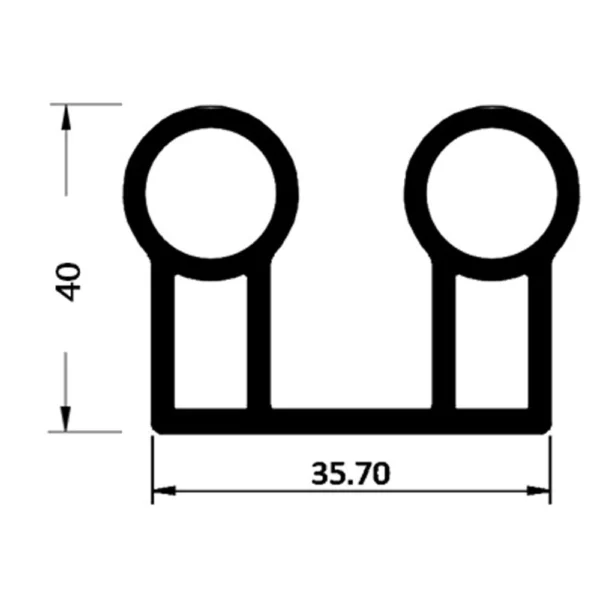
The section of BOB-K19 Cold Room Door Rubber that fits into the aluminum door leaf profile features a T-shaped base geometry. This geometry is designed to lock mechanically inside the aluminum channel.
Installation process:
- The door rubber is inserted into the aluminum profile by sliding it laterally
- The horizontal arms of the T-shape expand inside the channel
- The rubber becomes securely fixed and cannot move vertically or loosen over time
This installation method is especially suitable for factory-assembled cold room doors and ensures consistent quality and long-term stability.
Resistance to Ice Formation and Condensation
Sliding cold room doors are particularly prone to ice formation due to frequent opening and closing. Moist air entering the cold room can freeze around the door frame if sealing is insufficient.
BOB-K19 Cold Room Door Rubber minimizes this risk by:
- Maintaining continuous contact with the door frame
- Reducing air infiltration
- Supporting stable internal temperatures
As a result, ice buildup around the door perimeter is significantly reduced, improving door operation and safety.
Dimensional Variation for Project Compatibility
BOB-K19 provides the same technical performance and structural design as other models in its product family. Its distinguishing feature is its dimensional variation, which allows compatibility with different aluminum door profiles and project-specific requirements.
This dimensional flexibility offers:
- Easier integration into various door systems
- Improved installation accuracy
- Greater project adaptability without performance loss
Contribution to Energy Efficiency
Effective sealing plays a major role in reducing energy consumption in cold storage facilities. Cold Room Door Rubber (BOB-K19) helps:
- Prevent cold air leakage
- Reduce the workload on refrigeration systems
- Maintain stable internal temperatures
- Lower overall energy costs
This makes BOB-K19 a cost-effective solution for both new installations and retrofit projects.
Application Areas
BOB-K19 Cold Room Door Rubber is widely used in:
- Industrial cold storage facilities
- Food processing and logistics centers
- Automatic sliding cold room doors
- Monorail sliding door systems
- High-traffic cold storage environments
Technical Specifications
- Product Name: Cold Room Door Rubber
- Manufacturer: Bob Modüler
- Product Code: BOB-K19
- Material: EPDM
- Structure: Co-extruded (solid EPDM + sponge EPDM)
- Base Geometry: T-shaped base
- Application: Sliding cold room doors, automatic sliding doors, monorail sliding doors
Conclusion
Cold Room Door Rubber (BOB-K19) is a reliable and durable sealing solution designed for sliding cold room door systems. Its EPDM co-extruded structure, T-shaped base geometry, and excellent elasticity provide long-lasting sealing performance and improved energy efficiency. With its dimensional adaptability and robust construction, BOB-K19 is a trusted component within Bob Modüler’s cold room door rubber product range.